DIAGNOSTICS
FIRST
Not every diesel engine problem requires a rebuild. Diagnostics help determine whether a targeted repair, an in-frame rebuild, or a complete rebuild is appropriate for your truck or equipment.
A symptom or fault code alone cannot establish the repair scope, final cost, or completion date. Discuss the findings and any further inspection needed before approving rebuild work.
Same-day diagnostic appointments depend solely on the live calendar. Booking requires a $100 non-refundable, non-transferable deposit. An appointment is not a promise of same-day repair completion.
WHAT DIAGNOSTICS HELP YOU DECIDE
For a fleet or construction business, the decision is about repair scope and equipment availability—not just the engine. Tell us how the unit is used and the operating deadline so those needs can be discussed alongside the findings.
WHAT IS CONFIRMED?
Separate the operator's symptoms from test findings and anything that still needs inspection.
WHAT NEEDS APPROVAL?
Discuss the diagnostic scope and cost, including whether disassembly or additional testing is needed.
WHICH REPAIR PATH?
Review the evidence for a targeted repair or rebuild before committing to parts and labor.
TESTS & FINDINGS TO DISCUSS
The diagnostic plan depends on the engine, symptoms, access, and agreed scope. Not every job requires every test below, and a booking deposit does not define a complete rebuild inspection package.
1. HISTORY & VISUAL INSPECTION
The starting point is the reported concern, operating conditions, maintenance history, and inspection for visible leaks or damage. Record when the problem occurs rather than assuming a cause.
- Equipment and engine identification
- Mileage or engine hours
- Recent repairs and maintenance
- Operator observations and warning history
2. ELECTRONIC & PERFORMANCE CHECKS
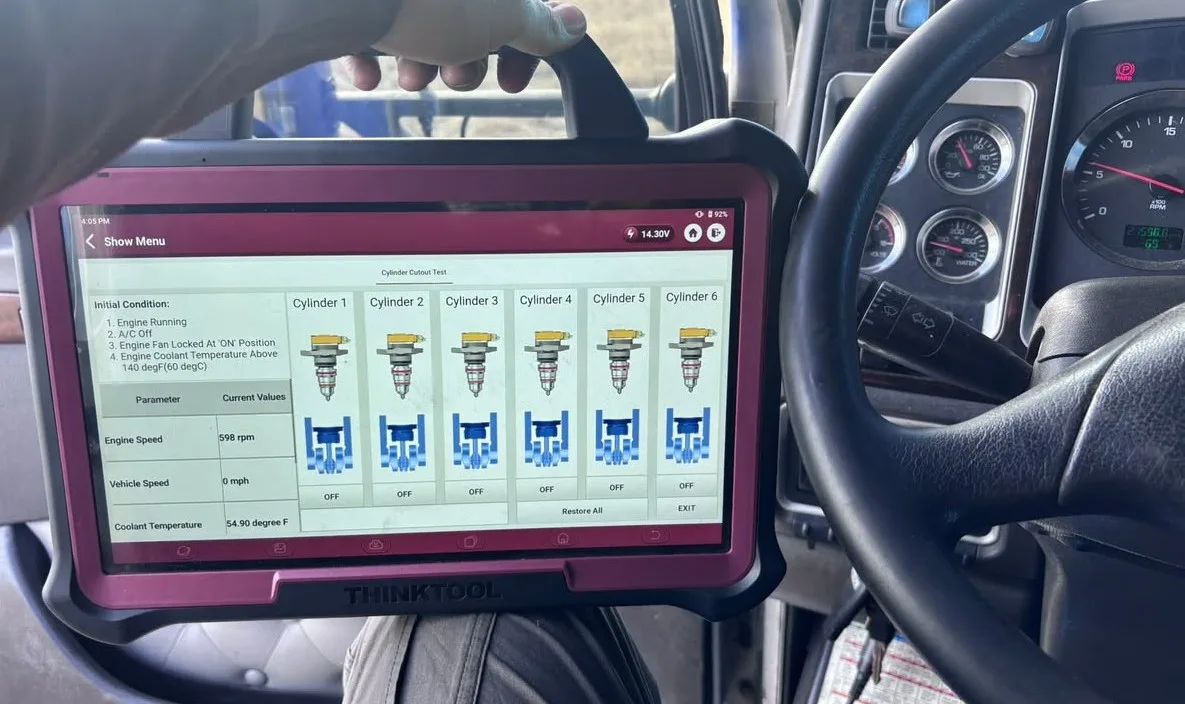
For electronically controlled engines, fault codes and live data can help guide further testing. A fault code is a diagnostic clue, not by itself proof that a component needs replacement or an engine needs rebuilding.
- Recorded diagnostic trouble codes
- Relevant live operating data
- Checks matched to the reported fault
- Fuel-system or boost checks where appropriate
3. COMPRESSION & LEAK-DOWN TESTING
Where appropriate for the engine and concern, compression and leak-down testing can help assess cylinder sealing. Results need to be interpreted against the applicable engine specifications and test conditions, alongside other findings.
- Suitability of the test for the engine
- Cylinder-by-cylinder results where tested
- Applicable specifications and test conditions
- Whether further inspection is needed
4. FLUID INSPECTION & FURTHER ASSESSMENT
Oil and coolant condition can provide useful evidence. Discuss whether sample analysis or additional inspection is needed. Initial diagnostics may not reveal all internal damage; some findings require authorized disassembly and measurement.
- Oil and coolant condition
- Available fluid-use or analysis records
- Evidence of contamination or wear
- Scope and approval for further inspection
FLEET & JOB-SITE DIAGNOSTIC QUESTIONS
WHAT SHOULD OUR DRIVER OR OPERATOR SEND?
Send the equipment and engine model if known, unit number, mileage or hours, warning lights or fault codes, and when the concern occurs. Include recent maintenance and repair history, equipment location, and whether it can be moved. Identify the person authorized to approve work and any job-site access requirements.
CAN YOU ASSESS EQUIPMENT THAT CANNOT COME TO THE SHOP?
Precision Diesel offers mobile diagnostics and repair. Call with the equipment type, location, symptoms, and access details to discuss the appropriate next step. Not every test or repair can be completed in the field. See our equipment and mobile services.
DOES A DIAGNOSTIC BOOKING GUARANTEE A FINISH DATE?
No. The live calendar shows diagnostic appointment availability, not repair completion slots. Further inspection, parts, machining, and the approved repair scope can affect the schedule. Discuss your operating deadline and the job-specific estimate; do not plan downtime around a generic case-study timeline. Review the rebuild cost factors.
WHAT SHOULD WE REVIEW BEFORE APPROVING A REBUILD?
Ask for the findings supporting the recommendation, the proposed parts and labor scope, and what remains uncertain. Clarify any further tear-down approval, machining arrangements, estimate exclusions, expected schedule, and quoted warranty terms. Compare in-frame work with complete rebuilding only where the engine condition supports those options.
HOW DOES THIS FIT OUR FLEET MAINTENANCE RECORDS?
Precision Diesel's fleet program uses Fullbay for maintenance history and per-unit service records. Share the asset identifier and relevant history, then discuss which diagnostic findings and approved work should be retained for your unit. Learn about fleet services and preventative maintenance. Service records do not by themselves guarantee regulatory compliance.
WHAT IF WE NEED HELP AFTER HOURS?
Our staffed shop hours are Monday–Friday, 8:00 AM–5:00 PM Pacific Time. All other times by appointment or emergency call. Emergency calls answered and mobile technicians dispatched 24 hours a day, 7 days a week.
For emergency service, call (509) 406-1081 directly rather than using the calendar. Dispatch availability is not a guaranteed arrival or repair completion time. See contact and arrival details.
START WITH THE FINDINGS
Check the live calendar for a diagnostic appointment, or call to discuss equipment access and mobile service. For rebuild planning, send the details through our existing estimate request.
Looking for examples? Read our educational rebuild planning guide, which distinguishes scenarios from documented jobs.